

The Parking Garage Is Where I Worry About My Wife the Most — Here’s Why, and What We Do About It
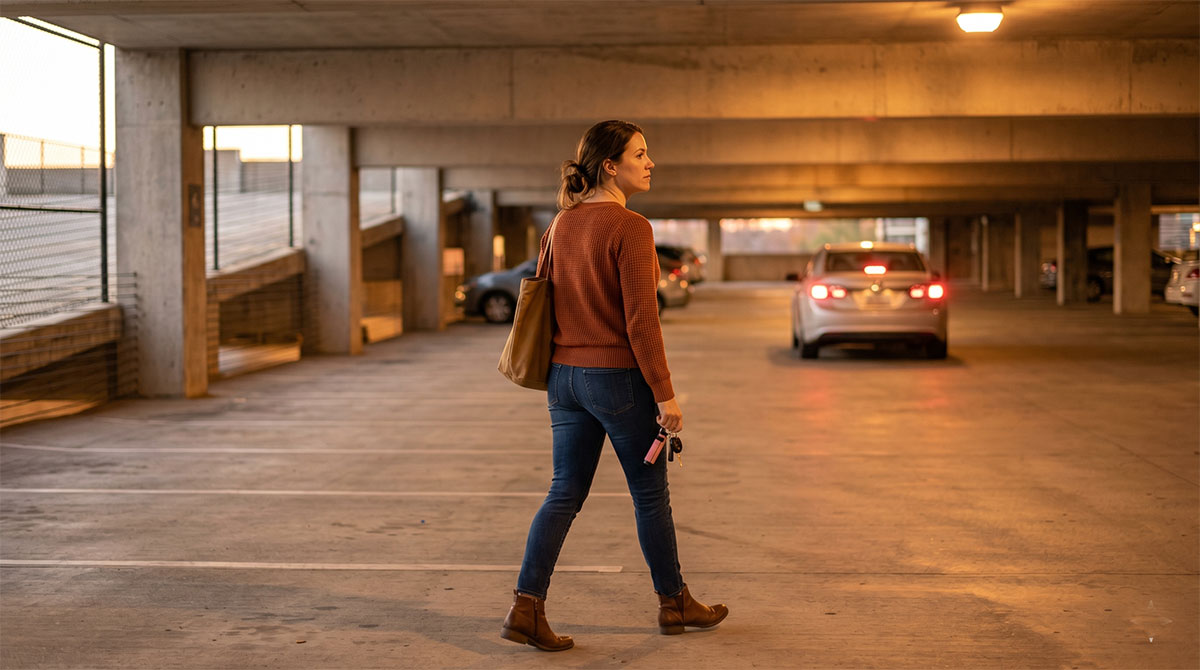
My wife parks on the third level of a concrete parking garage five days a week. Fluorescent lights that flicker. Concrete pillars wide enough to hide a grown man. An elevator that smells like motor oil and cigarettes. The first time I walked her to her car on a Saturday, I stood there in the middle of that echoing level and thought, this is where I worry about her.
Not the grocery store. Not her morning run. The parking garage.
And I’m willing to bet if you’re reading this — whether you’re a woman who parks in one every day, or a husband or father reading on behalf of someone you love — you already know exactly the feeling I’m talking about. That prickle at the back of the neck. The way your keys suddenly feel important in your hand. The instinct to move a little faster between your car and the elevator.
That feeling isn’t paranoia. It’s data. Your body is telling you something your conscious mind is trying to politely ignore. And as a husband, as a father of two daughters, and as somebody who spent years in real estate watching agents walk alone into environments exactly like this — I’ve stopped ignoring it. You should too.
Why Are Parking Garages Such a High-Risk Environment for Women?
Parking garages are, by their design, almost tailor-made for someone who wants to do harm.
Think about what a predator actually needs: a low-traffic space, limited sightlines, predictable patterns, and a target whose attention is divided. A parking garage gives them all four. There are long stretches with nobody around. Concrete pillars, SUVs, and columns break up visibility into a hundred little blind spots. Most people park in roughly the same area every day, which means routines are easy to learn. And a woman walking to her car is almost always doing three other things — digging for keys, balancing a purse and a coffee, answering a text, thinking about the meeting she just left.
That’s not her fault. That’s life. But it’s also the exact window someone looking to cause harm is watching for.
As a father of two daughters, this is the stuff that sits in the back of my head. My older girl is in college now, and the parking lot at her part-time job is the place I remind her about most. Not the walk across campus. The parking lot.
What Should You Do Before You Even Leave the Building?
The moment you start walking toward your car is already too late to start thinking about safety. By then, you’re in the environment. Preparation happens before you step out the door.
Here’s what I tell my wife and my daughters:
Have your keys in your hand before you leave the lobby. Not in your purse. Not in your pocket. In your hand, with the fob thumb-ready for the panic button. Digging for keys in a dim garage is one of the most common mistakes — and it’s one of the moments a predator is specifically watching for.
Have your self-defense tool in your other hand, not buried in a bag. A pepper spray clipped to a keychain that’s still in your purse is a pepper spray you don’t have. A stun gun in the bottom of a tote bag might as well be at home. The whole point of a non-lethal tool is that it’s accessible in the two or three seconds that matter. If you have to unzip, dig, and fumble, you don’t have a tool — you have a false sense of security.
Scan the space before you commit to it. When the elevator doors open, don’t just walk out. Take a breath, look both directions, notice who’s near your car, notice who’s near the exit. Three seconds of awareness before you step into the space is worth more than any gadget on the market.
Text somebody. A quick “heading to the car” message to your husband, your roommate, your sister. It costs nothing. It creates a timestamp somebody else is aware of. And it changes the odds in a way that’s hard to quantify but very real.
What Tools Actually Belong in a Woman’s Hand in a Parking Garage?
I get this question constantly, and my answer has gotten simpler over the years. You don’t need an armory. You need one primary tool you actually carry, plus a backup that lives somewhere you can reach.
Pepper spray is, for most women in most situations, the right primary tool for a parking garage. It works at distance, which means you don’t have to let someone get close to you. It’s legal in all 50 states with very few restrictions. It incapacitates quickly. And a keychain model lives exactly where your keys already are — in your hand on the way to the car.
A personal alarm belongs on every woman’s keychain, full stop. A 130-decibel alarm in a concrete parking garage is a sound you cannot unhear — it echoes, it carries, it makes the predator’s entire calculation fall apart. The whole strategy of someone targeting a woman in a garage depends on being quiet. A personal alarm breaks that strategy in half a second. One button, no aim required, no training.
A stun gun is an excellent secondary layer for the moments when someone has already closed distance. Many of the units I carry for my wife double as a powerful flashlight, which matters more than people realize in a dim garage — a bright beam scanning the space around your car changes how both of you behave. If yours does close the gap, a contact stun gun ends most confrontations in one or two seconds.
Here’s the part most articles won’t tell you: the best tool is the one you’ll actually carry every day. I’ve seen women buy the flashiest, most powerful stun gun on the market, use it once at home, and leave it in a drawer for three years. A $15 keychain pepper spray that rides on your keys every single day is infinitely more valuable than a $100 tool that lives in a junk drawer. Pick the one you’ll carry, and carry it.
How Should the People Around Her Show Up?
This is the part of the conversation nobody wants to have, and it’s the part I feel most strongly about.
Safety shouldn’t sit entirely on a woman’s shoulders. If you’re her husband, her father, her brother, her boyfriend, her coworker, her friend — you have a role, and most of us aren’t playing it well enough.
It doesn’t mean being overprotective. It doesn’t mean walking her to her car like she can’t handle herself. What it means is paying attention.
Ask her how her walk to the car felt. Notice when she mentions a guy in the elevator who gave her a weird vibe. Take it seriously — actually seriously, not dismissively — when she says she doesn’t like the north end of the garage at her office. When my wife tells me something felt off, my job is not to explain it away. My job is to listen and help her figure out what to do differently.
Offer to FaceTime her on the walk to the car if she works late. Ten minutes of your evening is not a big ask. To her, it’s a lifeline — and it’s the single most effective free self-defense tool on earth, because a predator watching from across a parking level is going to pick a woman who’s alone over a woman who’s clearly connected to somebody on the other end of a live call. Every time.
For the fathers of teenage daughters and college-age daughters reading this — have the conversation. Not the scary one. The practical one. What’s in your hand when you walk out? What’s your plan if somebody’s leaning against your driver’s door when you come around the corner? Where do you park when you work the closing shift? You’ll be surprised how much these conversations actually calm her down, not scare her. Preparation is the opposite of fear.
What Do You Do If Something Actually Happens?
I don’t want to dwell here, because fear-based writing has never helped anybody make a better decision. But I’d be doing you a disservice if I didn’t walk through the basics.
If something feels wrong before you reach your car — trust it. Turn around. Walk back to the building. Walk to another car where somebody else is. Pretend you forgot something. Don’t worry about being polite. The cost of being wrong and looking a little silly for ten seconds is zero. The cost of being right and ignoring it is everything.
If someone approaches you, put distance between you. Verbalize loudly — “Stop. Back up.” Loud commands are both a deterrent and a signal to anyone within earshot. If they keep coming, your pepper spray goes to work at 6 to 10 feet. Aim for the face, sweep side to side, and once they’re affected, you move — you don’t stand there watching. You move toward people, toward light, toward your car if you can get in and lock it, or back to the building.
The personal alarm comes on the instant anything starts. It’s not a last resort — it’s a first move. The sound changes the whole dynamic before the situation has a chance to develop.
And then you call for help. Not after you drive home. Not after you catch your breath. Right there, from inside your locked car with the engine running.
Frequently Asked Questions
Are parking garages actually more dangerous than parking lots?
Yes, generally speaking. Parking garages combine several risk factors that open lots don’t: low lighting, concrete structures that break up sightlines, limited foot traffic on upper floors, elevators and stairwells as additional choke points, and predictable entry and exit routes. Open surface lots have better visibility and more witnesses in most cases. That doesn’t mean parking lots are safe — it means garages deserve extra attention.
Is pepper spray or a stun gun better for a parking garage?
Pepper spray is usually the better primary tool because it works at a distance — you can use it before someone gets close enough to grab you. A stun gun requires contact, which means the threat has already reached you. Many women carry both: pepper spray on the keychain for primary defense, and a stun gun with a flashlight feature in a pocket or purse as a secondary layer.
What’s the best personal alarm for a parking garage?
Look for a personal alarm rated at 120 decibels or higher, with a simple pull-pin or single-button activation. Keychain models are ideal because they’re already in your hand on the way to your car. The decibel rating matters because parking garages echo — a loud alarm in that concrete environment is genuinely disorienting to anyone nearby and draws attention from multiple floors at once.
Should I park near the entrance or closer to the elevator?
Near the entrance when possible — especially on the ground level, well-lit, with the highest foot traffic and the shortest path to the street. Elevator-adjacent parking sounds convenient, but elevators are themselves isolated environments. The ideal spot is visible from a staffed area or security camera, brightly lit, and close to the main entrance. If your only options are in a less-ideal zone, that’s when carrying and planning matter most.
What should I do if someone is sitting in the car next to mine?
Don’t approach your car. Walk past it like it’s not yours, go back to the building, and either wait them out or ask security or a coworker to walk you out. Trust your gut on this one — if someone is sitting in a parked car for no obvious reason, positioned near your vehicle, your instinct to avoid them is a feature, not a flaw. This is exactly the kind of small decision that changes outcomes.
Is it worth asking security to walk me to my car?
Yes, every time you feel even slightly uneasy. That’s literally what they’re there for, and any decent security team would rather walk a hundred women to their cars uneventfully than have one incident happen on their watch. Don’t apologize for asking. Don’t feel like you’re overreacting. It’s a 90-second walk that costs nothing and solves the problem completely.
How do I teach my teenage daughter to handle parking lots and garages without scaring her?
Frame it as capability, not fear. The conversation isn’t “bad things happen” — it’s “you are capable, here’s the tool, here’s the habit.” Walk through it once together. Let her practice having her keys in hand and her pepper spray ready before she leaves the house. Teenagers respond to being treated as competent adults making smart choices, not as fragile people who need to be warned. Preparation builds confidence. Lectures build anxiety.
The Bottom Line
The parking garage doesn’t have to be the place you worry about the woman you love. A few habits, one or two tools she actually carries, and a family that checks in — that’s the whole strategy. Not complicated. Not expensive. Not paranoid. Just prepared.
Hope is not a plan. A pepper spray in her hand on the walk from the elevator to her car — that’s a plan.